

Salat Rulings
On this page you will find various useful tools regarding Salat, and many common issues which people face. Please choose which option you’d like to view:
This section guides you through performing the nightly recommended prayers.
Doubts
This section covers doubts in the number of raka'at you've prayed, doubts in various actions of Salat, what you can use for Sajda, & what to do about najasat.
Remedies
This section covers Sajda-e Sahw & Salatu 'l-Ihtiyat which are used in the above doubtful situations
Condensed Salat Method
Condensed method of prayer, useful for covering qadha salat, or under time pressures.
Salat & Travel
This section covers praying qasr from the GTA, Qibla directions on your flight, Qibla from any global location, Qasr Salat information, and determining whether you need to fast during travel.
Salatu 'l-Layl (صلاة الليل)
The Night Prayer: A Guide
Short on time? Making up a missed prayer? Should I pray full or essential items only? Want to learn more about Salatu 'l-Layl? Click here.
Prayers 1–4 Four Times × 2 Rakʻat = 8 Rakʻat Total
Pray it just like the Fajr prayer:
- 1st rakʻat: al-Fātiḥa + Sūrat al-Ikhlāṣ
- 2nd rakʻat: al-Fātiḥa + Sūrat al-Ikhlāṣ, with a qunūt
Prayer 5: ash-Shafaʻ 2 rakʻat
- 1st rakʻat: al-Fātiḥa + an-Nās (preferred)
- 2nd rakʻat: al-Fātiḥa + al-Falaq (preferred)
with the niyyat of RajaʻQunūt duʻā (in the 2nd rakʻat):
اللَّهُمَّ اغْفِرْ لَنَا وَ ارْحَمْنَا وَ عَافِنَا وَ اعْفُ عَنَّا فِي الدُّنْيَا وَ الْآخِرَةِ إِنَّكَ عَلَى كُلِّ شَيْءٍ قَدِيرٌAllāhumma-ghfir lanā wa-rḥamnā wa ʻāfinā waʻfu ʻannā fi'd-dunyā wa'l-ākhirati, innaka ʻalā kulli shay'in qadīr.
O Allah, forgive us, have mercy on us, grant us wellbeing, and pardon us in this world and the Hereafter. Verily, You have power over all things.
Prayer 6: al-Witr 1 rakʻat
First name is enough; Allah knows who you have in mind from your intention. Press Enter or Tab to jump to the next box.
… or paste a list
Saved only in this browser on this device. Use Download .txt to keep a backup, and Load .txt to restore it later or on another device.
- Recite, in order:
- al-Fātiḥa
- al-Ikhlāṣ ×3
- al-Falaq
- an-Nās
recommendedQunūt duʻā (in the 1 rakʻat):
- Begin with ṣalawāt: اللَّهُمَّ صَلِّ عَلى مُحَمَّدٍ وَآلِ مُحَمَّدٍ
Allāhumma ṣalli ʻalā Muḥammadin wa āli Muḥammad.
O Allah, send blessings upon Muḥammad and the family of Muḥammad.
- Ask forgiveness for 40 Shiʻas, each by name: اَللّهُمَّ اغْفِرْ لِـ....
Allāhumma-ghfir li-… (each name)
O Allah, forgive … (say each name and tap them as you go down the list).
No names set up yet, prepare them at the top of this prayer.
0 / 0 crossed off - Seek forgiveness for yourself, preferably 70 times: اَسْتَغْفِرُ اللهَ رَبِّي وَاَتُوْبُ اِلَيْهِ
Astaghfiru'llāha rabbī wa atūbu ilayh.
I seek forgiveness from Allah, my Lord, and I turn to Him in repentance.
- Ask pardon by saying al-ʻafw, as many times as you can: اَلْعَفْوُ
al-ʻafw
Pardon.
Imām Sajjād (a) used to say it 300 times.
- End with ṣalawāt: اللَّهُمَّ صَلِّ عَلى مُحَمَّدٍ وَآلِ مُحَمَّدٍ
▶ Watch the explainer lecture
Am I praying the full version or essentials only?
Only al-Fātiḥa is required in each rakʻat. The second surah is recommended, not required: pick a shorter surah, or recite al-Fātiḥa alone. Recommended parts show in grey.
Full shows everything. Essentials hides the recommended surahs and qunūt, leaving only whatʻs needed.
Iʻm short on time
If tiredness or time keeps you from all six, pray at least the last two: ash-Shafaʻ and al-Witr. If you canʻt manage those, pray at least al-Witr on its own.
When should I pray Salatu 'l-Layl?
The time of the night prayer is from midnight to Fajr, the closer to Fajr, the better.
It may also be prayed before midnight, helpful for those who canʻt stay awake late or wake early, and for the young.
If its time passes, it may still be prayed as qaḍā.
My posture and movement when praying
Standing is not required for the nawāfil. You may pray them sitting, walking, or in a moving vehicle, even if you are able to stand.
When praying while walking, facing the qibla is not required.
You may pray lying in bed with the niyyat of rajāʻ.
You may pray one rakʻat standing and the next sitting, even half a rakʻat standing and the rest sitting. If seated, you may stand up before the last āyah of the surah and then perform the rukūʻ in the normal way.
Can I use nawāfil for qaḍā?
You may use the daytime nawāfil to make up missed obligatory prayers. Your niyyat changes, but the hope is that you still receive reward for standing at nafila time.
- Nafila of Fajr → qaḍā of Fajr
- 4 rakʻat of Zuhr → qaḍā of Zuhr
- 4 rakʻat of ʻAṣr → qaḍā of ʻAṣr
- Nafila of Maghrib → qaḍā of Maghrib
- Nafila of ʻIshā → qaḍā of ʻIshā
The night prayer can also be used for qaḍā:
- 2 rakʻat of layl → qaḍā of Ṣubḥ
- 4 rakʻat → qaḍā of Zuhr
- 4 rakʻat → qaḍā of ʻAṣr
- al-Witr → pray on its own as nafila
- In place of the maghribayn nafila → pray their qaḍā
How can I build a habit of praying Salatu 'l-Layl?
Our Imāms emphasized sustaining the habit rather than taking on all the nawāfil at once and running out of steam. Imām ʻAlī (a):
Hearts have their times of eagerness and their times of reluctance; so when they are eager, take them to the recommended (nafila) prayers, and when they are reluctant, keep them to the obligatory ones.
Start gradually, perhaps on weekends. You can be selective: in the night prayer, pray only ash-Shafaʻ and al-Witr, or just al-Witr; in ʻaṣr, only 4 rakʻat or just 2; in maghrib, only 2.
Increase the number on holidays, especially in winter.
Why does Salatu 'l-Layl matter to me?
Among the five signs of a Shīʻah named by the 11th Imām is the prayer of the fifty-one, the daily obligatory prayers together with their nawāfil:
Beyond their reward, the nawāfil also make up for shortcomings in our obligatory prayers.
Sayyid Muhammad Rizvi · Provided for convenience. For anything specific to your situation, contact us.
Various Types of Doubts in Salat
If you encounter doubts regarding which rakat you’re currently in, the following form will help you remedy the situation.
Click on the button which relates to the number of rakats you’re having a doubt about.
Salat is invalid
Action: Immediately stop the prayer and simply start again.
Salat is invalid
Action: Immediately stop the prayer and simply start again.
If you encounter doubts during your salat regarding various actions or recitations, the following form will help you remedy the situation.
Note that the term ‘Munafiyat’ refers to any action which invalidates the prayer. (ie looking away from Qibla, talking, walking etc.)
Click on the button which relates to the issue you’re having.
Qara’at refers to the recitation of Surahs during Qiyam.
You know you forgot it:
You have doubts:
Note that Qunut is not a wajib act.
You forgot to perform Qunut but you:
This is the one second moment of standing, after Qara’at/Qunut, before bending for Ruku
General ruling: Knowingly, or unknowingly, adding or forgetting any Ruku, invalidates the prayer. However, if you have:
While going to Ruku, you accidentally go towards Sajda position:
Forgot 1 Sajdah within the:
Forgot 2 Sajdah within the:
Forgot first Tashahhud. If you remembered:
Forgot last Tashahhud. You remembered after salam and:
If you have any doubt whether Tashahhud was performed properly, at any moment – ignore it
Forgot Salam but remembered:
Note that if none of the permissible/discouraged items are available (including the last resort items listed in the disallowed section), use the sleeve of your clothing as a last resort.
Click the buttons to see some example items.
Preferable items are those from the earth, or something that grows from it but not used as food or clothing.
-Earth
-Plain paper
-Tissue (sourced from wood, not other materials)
-Natural straw mat
-Printed paper
-Tasbih beads (made from clay, not plastic)
-Walnut husk
-Date pits
-Maple leaf (not edible)
-Mango leaf
-Tea leaf
Note that the discouraged items are considered permissible but not preferable according to Ayatullah Sistani. The common opinion of other various mujtahideen is to disallow these items entirely.
-Turquoise (considered a precious stone)
-Aqiq (considered a precious stone)
-Marble (considered a precious stone)
-Granite (considered a precious stone)
-Brick
-Earthware
-Cement
-Terrazzo
-Fingernail
-Hand
-Asphalt (If there are no permissible or discouraged items available, this would be the ideal alternative, as a last resort)
-Tar (If there are no permissible or discouraged items available, this would be the ideal alternative, as a last resort)
-Silk paper (comes from silk, and is also used as an item of clothing)
-Gold/Silver coin and other metals (found in earth, but not considered to grow from it)
-Glass (created from sand, however underwent drastic transformation)
-Plastic (doesn’t grow from the earth)
-Water lilies (doesn’t grow from the earth)
-Pan leaf (edible item)
-Cotton (used as an item of clothing)
-Lettuce (edible item)
-Coal
How to deal with discovered najasat on the body or clothing. Depending on when the najasat was discovered, click the appropriate button.
If the time remaining for Salat is:
If you believe it occured after starting salat, and it is:
If you knew of najasat but forgot and prayed with it:
Remedies for Doubts in Salat
Below are two items which are used when there are doubts or mistakes made in Salat.
Sajda-e Sahw (the ‘sajdah for missing something’)
Salatu ‘l-Ihtiyat (prayer done on a precautionary basis)
Condensed Salat Method
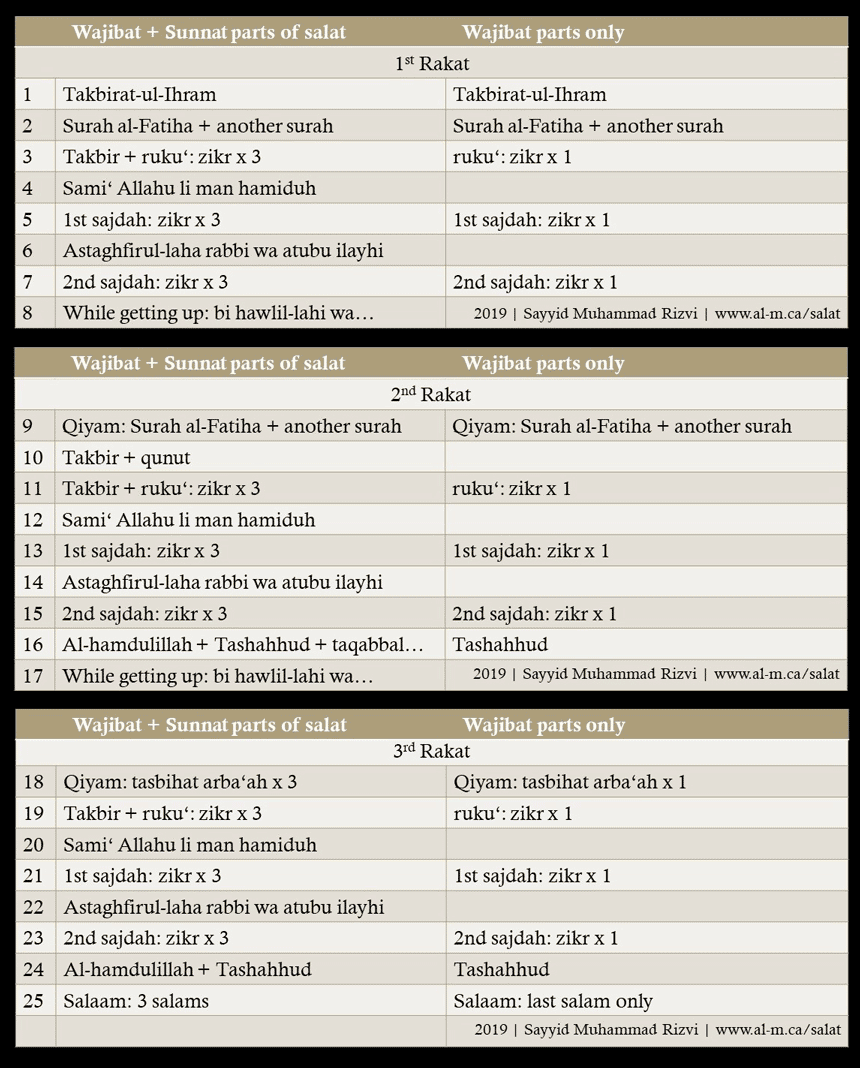
If you are fulfilling Qadha Salat, or are pressed for time, use the charts provided as an aid to maximize your time by completing only the Wajib portions of your prayer. Click the various Rakat tabs to view the corresponding chart. Note that this is not to be done on a regular basis, as the full method is highly recommended, and is considered to be the typical length/list for Salat.
Click on the chart for a larger image.
Remember, for zikr x 1, if only saying “Subhanallah”, saying it three times counts as a single zikr.
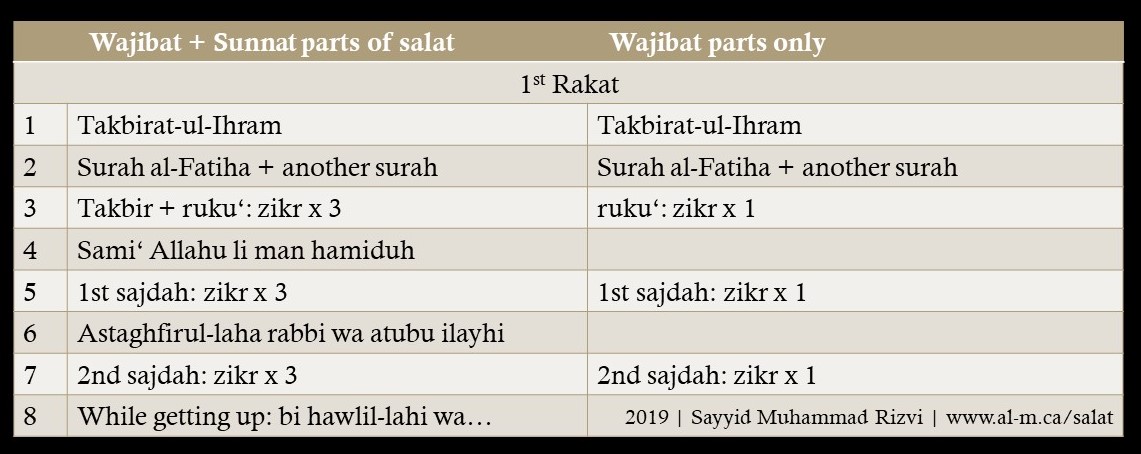
Click on the chart for a larger image.
Remember, for zikr x 1, if only saying “Subhanallah”, saying it three times counts as a single zikr.
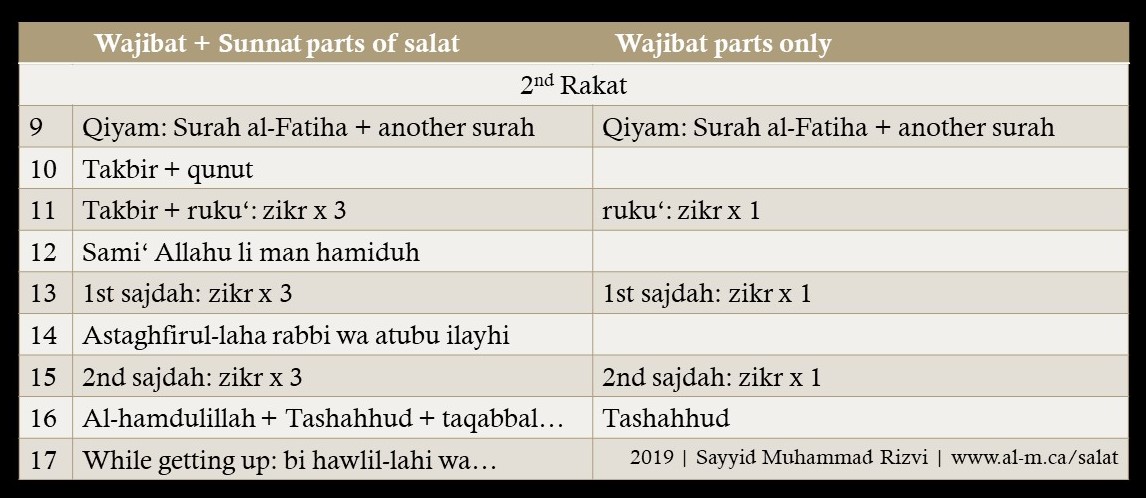
Click on the chart for a larger image.
Remember, for zikr x 1, if only saying “Subhanallah”, saying it three times counts as a single zikr.
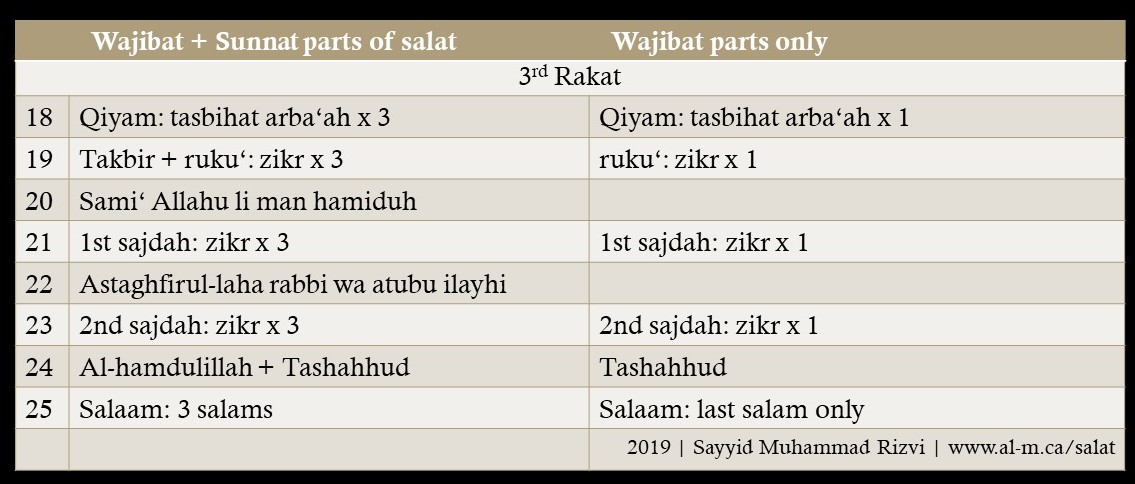
Click on the chart for a larger image.
Remember, for zikr x 1, if only saying “Subhanallah”, saying it three times counts as a single zikr.
Wudhu
The Acts of Wudhu
Wudhu is necessary for every ṣalāt, including for the nawāfil prayers.
The recommended acts of wudhū are given in italics.
- Making the intention (niyyat) in one’s mind.
- Washing the hands two times.
- Gargling three times.
- Rinsing the nose three times.
- Washing the face 1st time and then the 2nd time.
What is the face?
What is “face?” From the hairline to the end of the chin in length, and what comes between the thumb and the middle finger in width of an average person.
- Washing the right fore-arm 1st time & then the 2nd time.
How to wash the arms
The arms should be washed from the elbows to the fingertips.
- Washing the left fore-arm 1st time & then the 2nd time.
How to wash the arms
The arms should be washed from the elbows to the fingertips.
- Wiping the head with 1 finger or with 3 fingers together.
How to wipe the head
The wiping of the head means to wipe a wet finger of the right hand from the crown of the head to the hair-line. Wiping of the head can be done on any part of the quarter of the head that is over the forehead.
The wiping of the head and the feet should be done only by the remaining wetness of the hands after having washed the face and the forearms.
What would you do if the wetness of the hand has dried up? You can use the wetness of the beard to rewet your hand for wiping. (In case of a woman, she can use the wetness of the face to rewet her hand for wiping.)
- Wiping the right foot with the right hand.
How to wipe the feet
The feet must be wiped by the palm or the fingers of the hand from the finger-tips of the foot to the base of the ankle.
- Wiping the left foot with the left hand.
How to wipe the feet
The feet must be wiped by the palm or the fingers of the hand from the finger-tips of the foot to the base of the ankle.
Washing face & fore-arms
What about washing them the second time?
- Some jurists: it is simply permissible.
- Most jurists: it is recommended.
- Khu’i & Sistani: washing the left fore-arm for the second time is neither recommended nor forbidden; both recommend that it is better not to wash it the second time.
What does ‘the first’ & ‘the second’ wash mean?
- It all depends on your intention.
- Sistani: the 2nd washing should consist of only one wash, i.e., pouring the water once & then wiping over it once.
Video of Ayatullah Sistani doing wudhu
Dua in Wudhu
Download this PDF, or print it to keep beside your sink when performing wudhu, to recite the dua’s taught by Imam Ali at every step of your wudhu

Inability to Maintain Taharat
The two most common problems related to ritual purity (ṭahārat) are the cases of mabṭūn and maslūl.
“Mabṭūn” means one who cannot control the bowel movements resulting in discharge of stool or gas; both invalidate the wudhū and ṣalāt.
“Maslūl” means one who has no bladder control resulting in discharge of urine; this also invalidates the wudhū and ṣalāt.
There are three situations:
If a person knows of a certain time segment, let us say during the late afternoon, when he can maintain the ṭahārat for so long that at least the obligatory actions can be done properly, then he must wait for that time-span even if that means that he has to do the noon and afternoon ṣalāt at the end of time.
If a person can maintain the ṭahārat for part of his ṣalāt but not for the whole ṣalāt, then he should do wudhū and ṣalāt, and just ignore the najāsat.
However, in this case, it is better to do a new wudhū for the next ṣalāt.
If a person cannot maintain the ṭahārat even for a part of his ṣalāt, then he should do his wudhū or tayammum, and do the ṣalāt. He should just ignore the element(s) that invalidates the wudhū and continue his ṣalāt.
In this case, his one wudhū will be valid even for the next ṣalāt unless it becomes void because of other causes like sleeping.
In all these cases, one should wear something like an adult diaper to prevent the najāsat from touching other parts of the body. It is not necessary to change it for each ṣalāt.
Teach Your Child How to Pray with Maulana Rizvi
Play the below audio clips of Zuhr & Asr Salat, with your child following along. All recitations are done aloud for better understanding.
Iqama, Niyyat, & Zuhr Prayer
Iqama, Niyyat, & Asr Prayer
Salat & Travel
Click here to visit al-m.ca/travel for rulings and information related to:
Praying Qasr while travelling from the Greater Toronto Area (GTA)
An interactive map that helps determine whether you’re travelling outside of city boundaries, determining whether you need to fast or pray qasr.
Fasting During Travel?
An easy to use form which will determine whether you need to fast on your trip, within two clicks.
Qibla Direction on a Plane
Easy to use website which will determine your prayer direction on your particular flight.
Qibla Direction from Anywhere in the World
Easy to use website which will determine your prayer direction from any location, including your current one.
Qasr Salat Information and Doubts
How & when to pray qasr, and what to do when you have doubts